Month-of-Year Seasonality in Trading
Jan 17, 2026
What Happens When You Do the Analysis Correctly
Keywords: month of year seasonality, seasonality in trading, calendar effects trading, trading seasonality analysis, statistical power trading
Reading time: ~7–9 minutes
Introduction: The Myth of Month-of-Year Effects
Month-of-Year (MOY) seasonality is one of the most persistent ideas in trading folklore.
Claims like “January is bullish” or “September is weak” are repeated so often that they are rarely questioned.
But repetition is not evidence.
In this study, we analyze EUR/USD daily OHLC data spanning 2005–2025, applying a complete, statistically disciplined Month-of-Year framework to one of the most liquid markets in the world.
The result surprises many traders:
After proper testing, no calendar month shows a statistically significant return edge.
This is not a negative outcome.
It is a correct outcome.
Stage 1 — Data Preparation and Calendar Alignment
The analysis begins with strict data hygiene:
Daily returns, not prices
Alignment by calendar month
Pooling the same month across all years
Treating each year as an independent observation
No smoothing, no pre-filtering
At this stage, the objective is simple:
Ensure January is always January.
No assumptions are made about profitability.
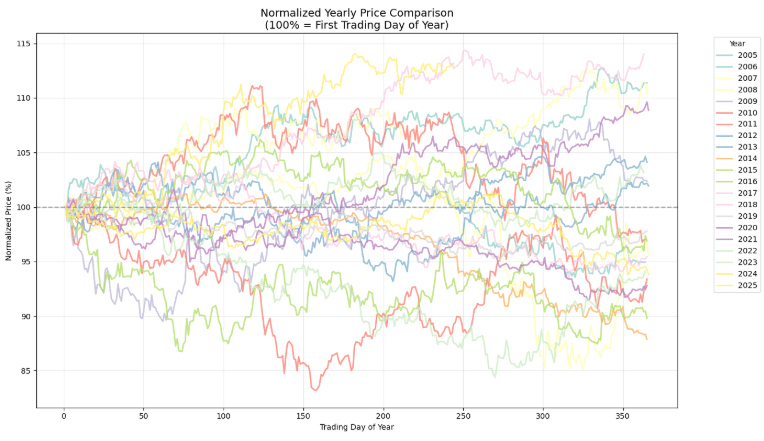
CHART 1 — Raw prices vs Returns

Stage 2 — Descriptive Aggregation by Month
For each calendar month, we compute:
Average return
Standard deviation
Win rate
Number of years observed
This step is intentionally descriptive.
It answers:
What does the raw data appear to show?
CHART 2— Average Monthly Returns (Descriptive Only)
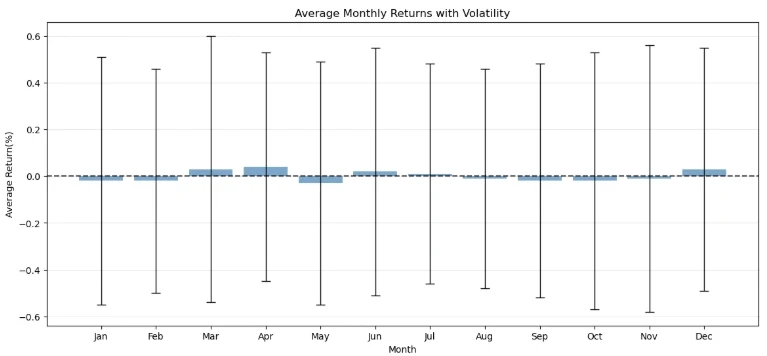
At this point, some months may look better or worse than others.
This is exactly where most analyses stop — and exactly where mistakes begin.
Stage 3 — Statistical Significance Testing
To test whether apparent patterns are real, each month’s average return is evaluated against the null hypothesis:
H₀: Average monthly return = 0
We compute:
t-statistics
p-values
A practical interpretation:
|t| < 1.5 → noise
1.5 ≤ |t| < 2 → weak / unstable
|t| ≥ 2 → statistically meaningful
CHART 3 - Month-of-Year t-Statistics
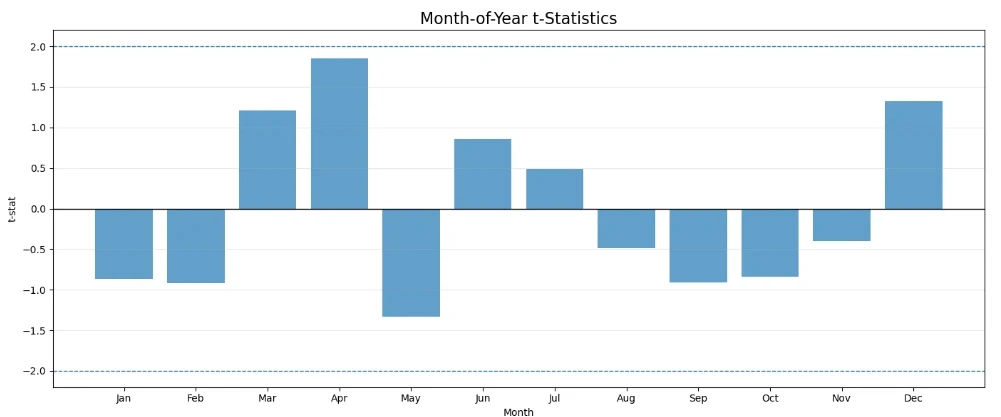
Result:
No month crosses the ±2 threshold.
This means:
There is no statistically detectable Month-of-Year return edge.
Stage 4 — Statistical Power: Why This Result Matters
A common reaction is:
“Maybe the sample is too small.”
That is a valid concern — which is why statistical power must be examined.
Statistical power depends on:
Effect size
Volatility
Number of years observed
Significance threshold
CHART 4 - Sample size vs t-stat
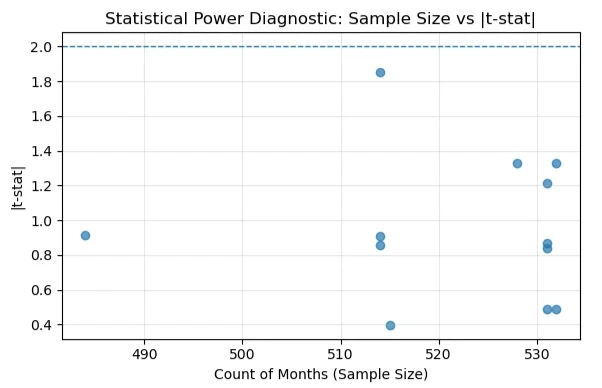
Key insight:
Most months have adequate sample size
Yet |t| remains low
This indicates absence of edge, not lack of data
This is an important distinction:
Low power + no signal → inconclusive
Adequate power + no signal → no edge
We observe the latter.
Stage 5 — Quality Filtering Confirms the Result
To ensure nothing meaningful is missed, we examine quality dimensions:
Win rate vs t-statistic
Directional consistency
Economic magnitude
CHART 5 - Win rate vs t-statistics scatter plot
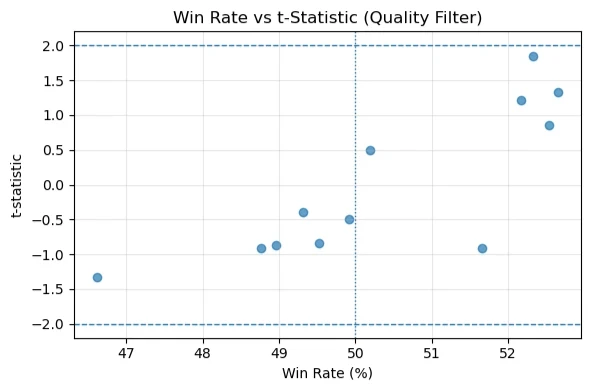
Top-right quadrant
→ frequent wins + strong statistical edge (clean, stable)
Top-left quadrant
→ low win rate but strong t-stat (asymmetric payoff, trend-like)
Bottom-right quadrant
→ high win rate but weak edge (danger zone)
Bottom-left quadrant
→ noise
Reference lines:
|t| = 2→ minimum statistical credibilitywin_rate = 50%→ coin-flip baselineObservation:
Some months win more often
Others have slightly higher returns
None combine frequency, magnitude, and statistical strength
This confirms the earlier conclusion
Stage 6 — What “No Significant Months” Actually Means
This result does not mean:
Markets are random
Seasonality is useless
Research failed
It means something much more precise:
Month-of-Year alone is too coarse to capture persistent market structure.
Calendar effects that survive tend to exist at finer granularity:
Day-of-Month
Day-of-Year
Event-driven windows
Regime-dependent conditions
Month-level aggregation averages away these effects.
Conclusion
This study demonstrates an uncomfortable but important truth:
Month-of-Year seasonality does not provide a standalone trading edge.
That conclusion is not pessimistic — it is liberating.
It prevents wasted effort, false confidence, and overfitting.
Good research does not aim to find something.
It aims to find the truth.
In markets, knowing where there is no edge
is just as valuable as knowing where there is one.
What Comes Next
Month-of-Year analysis removes false expectations.
Seasonality doesn’t disappear — it moves to finer resolution.
Next in this series:
Day-of-Month (DOM): flow-driven calendar effects
Day-of-Year (DOY): short seasonal windows months average away
Same framework. Higher resolution.